Tirana: Albania's Capital and Beating Heart

Albania, a small yet captivating country nestled in Southeastern Europe, has a capital city that embodies its transformation from communist isolation to dynamic European democracy. Tirana (Tirane in Albanian) is the capital of Albania, a distinction it has held officially since 1920, though its journey to prominence spans centuries of Albanian history.
For travelers arriving at Tirana International Airport Nene Tereza (TIA), the capital sits just 17 km northwest along the A1 highway, making it the natural first stop for exploring Albania. Understanding Tirana's role as political, economic, and cultural nucleus helps contextualize the entire Albanian experience, whether you're renting a car in Tirana to explore the city or planning routes to coastal destinations.
Historical Journey to Capital Status
Albania's capital has not always been Tirana. Throughout medieval and Ottoman periods, different cities held administrative prominence based on strategic, economic, or military importance. Shkodra, in the north near Montenegro, served as a significant center during Illyrian and early medieval times. Durres, with its ancient Roman heritage as Dyrrachium, functioned as the Adriatic gateway and held administrative weight. Kruja, perched in the mountains north of Tirana, became legendary as the stronghold of national hero Gjergj Kastrioti Skanderbeg during his 15th-century resistance against Ottoman expansion.
The Ottoman Empire conquered Albania in the late 15th century, and administrative centers shifted according to imperial needs. Tirana itself was founded as an Ottoman town in 1614 by Sulejman Pasha Bargjini, who established a mosque, hammam, and bakery at a crossroads location. For three centuries, Tirana remained a modest provincial town of 12,000 inhabitants, notable primarily for its bazaar and strategic position at the intersection of routes connecting the Adriatic coast with interior valleys.
Albania declared independence from the Ottoman Empire on November 28, 1912, in Vlora. The new nation initially designated Vlora as its first capital, but the unstable political situation and World War I chaos meant the capital shifted multiple times. In 1920, during the Congress of Lushnja, Albanian leaders chose Tirana as the permanent capital for pragmatic reasons: its central geographic location within Albanian territory, distance from contentious border regions claimed by neighboring states, and room for expansion on the Tirana plain between Mount Dajti to the east and agricultural lowlands to the west.
Since that designation 106 years ago, Tirana has grown from a town of 12,000 to a metropolitan area approaching 1 million residents, concentrating roughly one-third of Albania's population within its urban sprawl.
Geography and Layout of the Capital
Tirana sits at 41.33 degrees north latitude and 19.82 degrees east longitude, on a plain at approximately 110 meters elevation, with terrain gradually rising eastward toward Mount Dajti (1,613 meters), which forms a dramatic backdrop visible from throughout the city. The Lana River, though modest and often channeled underground in the city center, flows north-south through Tirana, historically providing water for the settlement.
The city's layout radiates outward from Skanderbeg Square (Sheshi Skenderbej), the central plaza covering 40,000 square meters. Communist-era urban planning imposed wide boulevards radiating from the square: Deshmoret e Kombit Boulevard runs south toward the Pyramid of Tirana and government buildings; Rruga e Durresit (Durres Street) heads northwest toward the port city 38 km away; Rruga e Elbasanit extends southeast toward the interior.
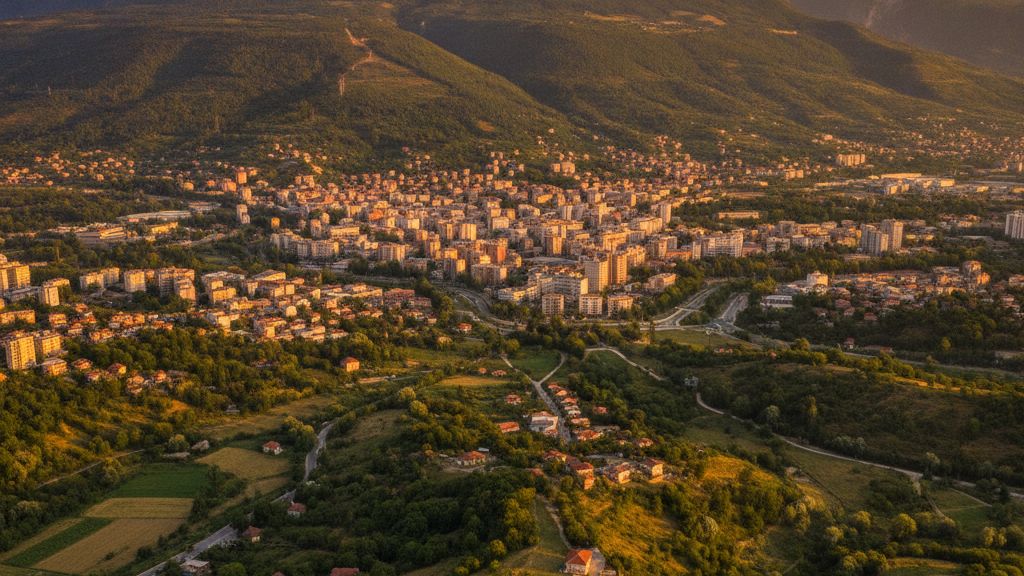
Modern Tirana extends in concentric rings. The Blloku neighborhood, once the exclusive residential compound for communist party elite and closed to ordinary citizens, transformed after 1991 into the city's trendiest district, packed with cafes, restaurants, boutiques, and nightlife venues. The southern districts around the artificial Lake of Tirana (Liqeni Artificial) offer recreational green space. Northern and western suburbs stretch toward Tirana Airport, with industrial zones, commercial developments, and newer residential blocks.
Driving in Tirana presents challenges typical of rapidly developing Balkan capitals: aggressive driving styles, frequent lane changes without signals, pedestrians crossing unexpectedly, and parking scarcity in the center. Most car rental pickups in Tirana occur either at TIA airport or at offices along Rruga e Durresit. For city exploration, street parking requires paid tickets from kiosks (typically 50-100 lek per hour in the center), while underground garages near Skanderbeg Square charge 200-300 lek for several hours. Traffic peaks between 08:00-09:30 and 17:00-19:00 on weekdays.
Landmarks and Cultural Attractions
Skanderbeg Square underwent complete reconstruction between 2008-2017, removing vehicles and creating a pedestrian plaza dominated by the equestrian statue of Albania's national hero Gjergj Kastrioti Skanderbeg. Surrounding the square, key buildings represent different architectural eras: the Et'hem Bey Mosque (1794-1821) with delicate frescoes survived communist atheism campaigns; the National History Museum (1981) features a monumental socialist-realist mosaic facade titled "The Albanians"; the Tirana International Hotel tower (1979) exemplifies communist modernism; the Opera House (reopened 2023 after renovation) hosts performances by the Albanian National Opera and Ballet.
The Clock Tower (Kulla e Sahatit), built in 1822 next to the Et'hem Bey Mosque, stands 35 meters tall and offers views over the square for visitors willing to climb its spiral staircase. During the Ottoman period, it regulated commercial activity hours; today it serves as an iconic landmark.
Bunk'Art 1 and Bunk'Art 2, converted communist-era nuclear bunkers, function as museums exploring Albania's totalitarian past. Bunk'Art 1, located on the northern outskirts near Mount Dajti, occupies a massive 5-floor underground complex built for communist leader Enver Hoxha and the political elite. Bunk'Art 2, in the city center, focuses on the history of the Albanian police and secret services under dictatorship. Both installations combine historical artifacts with contemporary art, creating powerful reflections on memory and trauma.
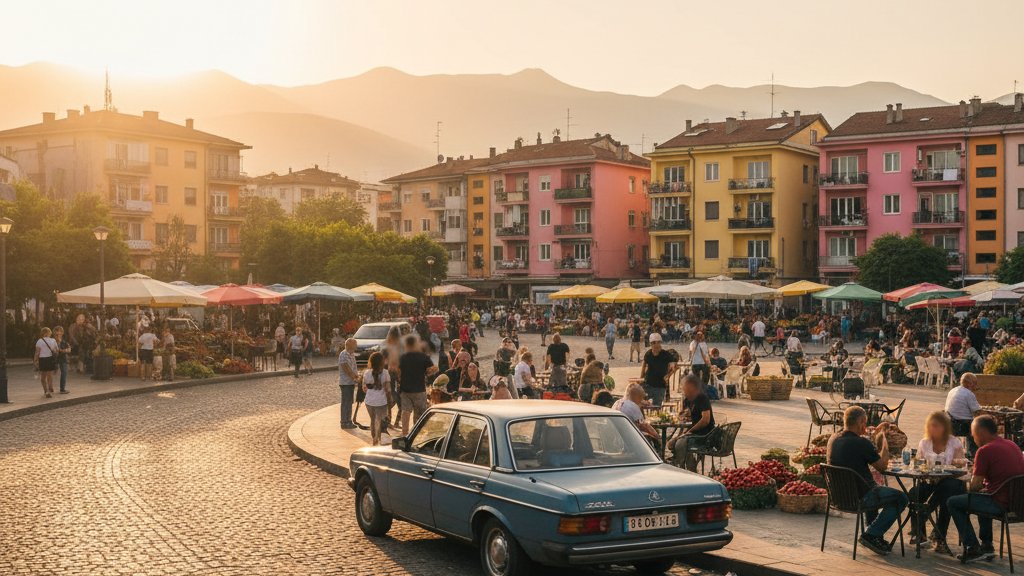
The National Art Gallery exhibits works from Albanian painters and sculptors spanning the 20th century, including socialist realism from the communist era alongside contemporary pieces. The Pazari i Ri (New Bazaar), renovated in 2017, functions as Tirana's food market, where vendors sell fresh produce, cheese, meat, and traditional byrek pastries.
One cannot overlook Tirana's architectural transformation initiated by former mayor Edi Rama (2000-2011), who commissioned the painting of communist-era apartment blocks in vivid colors and geometric patterns. This project addressed the psychological gloom of gray concrete while awaiting funding for deeper urban renewal. The result created a signature visual identity, with orange, pink, yellow, and green facades now characteristic of Tirana's streetscape.
Government and Administrative Role
As Albania's capital, Tirana hosts all central governmental institutions. The Prime Minister's Office sits in the former Palace of Brigades on Deshmoret e Kombit Boulevard. The Albanian Parliament (Kuvendi) convenes in a modernist building south of the city center. Individual ministries occupy various buildings throughout the governmental district.
The Presidential Palace (Pallati Presidencial) serves as the ceremonial residence of Albania's head of state, though the president's role is largely symbolic under Albania's parliamentary system. The Constitutional Court, Supreme Court, and other judicial bodies maintain headquarters in Tirana, consolidating legal authority in the capital.
Foreign embassies and diplomatic missions cluster in several neighborhoods, with many located in the Blloku area and along major boulevards. The United States, United Kingdom, Germany, Italy, Turkey, and other nations maintain embassy compounds in Tirana, reflecting Albania's integration into Euro-Atlantic structures - Albania joined NATO in 2009 and holds EU candidate status.
Municipal administration for Tirana itself operates from the Municipality Building near Skanderbeg Square, managing urban services, public transport, waste collection, and local infrastructure for a population that swells above 800,000 during working hours as commuters arrive from surrounding districts and towns.
Economic Center and Business Hub
Tirana generates approximately 40 percent of Albania's GDP despite containing one-third of the population, reflecting its concentration of higher-value economic activity. The service sector dominates, with banking, telecommunications, retail, and professional services headquartered in the capital. Major Albanian banks maintain flagship branches around Skanderbeg Square and along Deshmoret e Kombit Boulevard.
Foreign investment gravitates toward Tirana due to infrastructure advantages and market access. International brands established Albanian operations here: retail chains, automotive dealerships, technology companies, and hospitality groups chose Tirana as their entry point. The city's construction boom over the past two decades reshaped the skyline with office towers, shopping centers, and residential complexes, though quality varies considerably.
The Blloku neighborhood transformed into a commercial and entertainment district with property values now matching those in regional capitals. Cafes charge 150-300 lek for espresso, restaurants serve diverse cuisines from traditional Albanian to Japanese and Mexican, and boutiques stock international fashion brands. This contrasts sharply with the district's history as a forbidden zone for ordinary Albanians during communism.
Industrial activity remains limited within Tirana proper, with factories and warehouses concentrated in western and northern outskirts along the road toward Durres. The Port of Durres, Albania's primary seaport 38 km west on the Adriatic coast, functions as Tirana's maritime gateway, handling cargo and passenger ferries to Italy.
Planning to explore beyond the capital? Compare car rental rates across Albanian cities to find the best option for your route from Tirana to the coast or mountains.
Transportation and Getting Around
Tirana International Airport Nene Tereza (TIA, airport code TIA) serves as Albania's primary airport, located 17 km northwest of the city center near the village of Rinas. The airport connects Tirana to European hubs operated by airlines including Wizz Air, Lufthansa, Austrian Airlines, Turkish Airlines, Aegean Airlines, and others. No direct intercontinental flights serve Tirana; passengers from North America or Asia connect through European hubs.
From TIA to central Tirana, travelers choose between taxi (fixed fare around 2,500-3,000 lek to the center), airport bus service (300 lek), or rental car pickup at the airport. The car rental approach offers maximum flexibility for travelers planning to explore regions beyond the capital, with major rental companies maintaining desks in the arrivals hall.
Within Tirana, public transportation consists of a bus network operated by the municipality with routes covering most districts. Fares cost 40 lek paid to the driver or through a card system. Service can be crowded and irregular. Most residents rely on private cars, contributing to traffic congestion. Walking remains practical in the city center, with Skanderbeg Square to Blloku covering roughly 2 km on foot.
The city lacks a metro system, though plans for a light rail line have circulated for years without implementation. Bike lanes appear sporadically but have not formed a comprehensive network; cycling in Tirana traffic requires caution and experience.
For intercity travel, buses depart from multiple stations around Tirana depending on destination. Furgons (minibuses) to Durres leave from near the National Stadium; buses to southern destinations like Saranda and Vlora depart from the south terminal. The road network radiating from Tirana includes: A1 motorway to TIA airport and Durres; SH2 highway southeast toward Elbasan; SH1 north to Shkodra; and SH8 south via Fier toward the Albanian Riviera.
Climate and Best Time to Visit
Tirana experiences a Mediterranean climate modified by its inland position and elevation. Summers are hot and dry, with July and August daytime temperatures typically reaching 30-35 degrees Celsius, occasionally exceeding 38 degrees during heatwaves. The plain traps heat, and the city lacks the coastal breeze that moderates temperatures in Durres or Vlora. Air conditioning is essential in hotels and restaurants during summer months.
Winters are mild but wet, with December through February averaging 8-12 degrees Celsius. Frost occurs occasionally overnight, but snow accumulation in the city center is rare, perhaps one or two events per winter. Mount Dajti receives more consistent snow, and the cable car provides access to winter scenery overlooking the capital.
Spring (April-May) and autumn (September-October) offer ideal conditions for exploring Tirana: comfortable temperatures between 18-25 degrees, lower tourist crowds compared to coastal areas, and vibrant seasonal changes in vegetation around the city's parks and boulevards. Rainfall peaks in November and December, with afternoon thunderstorms common during those months.
| Month | Avg High (Celsius) | Avg Low (Celsius) | Rainfall (mm) | Visitor Experience |
|---|---|---|---|---|
| January | 12 | 3 | 135 | Cool, wet; few tourists |
| April | 19 | 9 | 90 | Pleasant spring weather |
| July | 32 | 19 | 35 | Hot, dry; peak tourist season |
| October | 21 | 12 | 110 | Comfortable autumn temperatures |
Practical Information for Visitors
Albanian lek (ALL) is the official currency, with exchange rates hovering around 100 lek per euro in 2026. ATMs accepting international cards are widespread in Tirana, particularly around Skanderbeg Square and in the Blloku district. Many restaurants, hotels, and shops accept euros informally, though change is given in lek at variable exchange rates.
Albanian is the official language, written in Latin script and related to no other living language (it forms its own branch of the Indo-European family). In Tirana, younger residents often speak English, particularly in tourist areas, hotels, and restaurants. Italian is understood by many due to geographic proximity and Italian television broadcasts received in Albania during the communist era. Shop signs and restaurant menus in tourist zones typically include English translations.
Safety in Tirana is generally good by regional standards. Petty theft (pickpocketing, bag snatching) occurs in crowded areas like the bazaar or on buses, but violent crime against tourists is rare. Driving risks include aggressive local driving habits and poorly maintained side streets. Walking at night in central districts is safe, though outlying neighborhoods may lack street lighting.
Accommodation ranges from luxury hotels around Skanderbeg Square to budget guesthouses in residential neighborhoods. International chains including Hilton, Marriott, and Mak Albania Hotel maintain properties in Tirana. Mid-range hotels charge 50-80 euros per night for double rooms. Booking in advance is advisable during summer months and around holidays.
Food in Tirana reflects traditional Albanian cuisine with increasing international influence. Byrek (savory pastry with cheese, meat, or spinach), tave kosi (baked lamb with yogurt), and grilled meats dominate menus. Cafes outnumber restaurants, and coffee culture is central to social life - espresso, macchiato, and cappuccino consumed at all hours. A meal at a mid-range restaurant costs 1,200-2,000 lek per person including a main course, side, and soft drink.
FAQ
What is the capital of Albania, and why was Tirana chosen over other cities like Durres or Shkodra for this role?
Tirana is the capital of Albania, officially designated in 1920 during the Congress of Lushnja. It was chosen over coastal Durres and northern Shkodra primarily for its central geographic location within Albanian territory, equidistant from contested border regions with Yugoslavia and Greece. The inland position offered strategic security compared to the exposed Adriatic coast, and the Tirana plain provided space for expansion that mountainous Shkodra lacked. At the time, Tirana's modest size (12,000 inhabitants) also represented a neutral choice among competing regional power centers, reducing factional tensions in the newly independent state.
How far is Tirana International Airport from the city center, and what transportation options connect the airport to downtown Tirana for travelers who want to rent a car or take public transport?
Tirana International Airport Nene Tereza (TIA) sits 17 km northwest of Skanderbeg Square via the A1 highway, a drive taking 20-30 minutes depending on traffic. Travelers have three main options: rental car pickup at the airport terminal where all major companies maintain desks; fixed-fare taxi for approximately 2,500 lek to central hotels; or airport bus service (Rinas Express) costing 300 lek per person operating hourly during daytime. For travelers planning to explore regions beyond Tirana - the Albanian Riviera, northern mountains, or archaeological sites - rental car pickup at TIA provides immediate mobility without navigating city traffic to reach a downtown agency.
What are the must-see landmarks and cultural attractions in Tirana that visitors should prioritize when they have limited time in Albania's capital city?
With limited time, prioritize Skanderbeg Square as the starting point - it concentrates the National History Museum, Et'hem Bey Mosque, Clock Tower, and Opera House within walking distance. Allocate 1-2 hours for the National History Museum's overview of Albanian civilization from Illyrian times through communism. Walk south along Deshmoret e Kombit Boulevard to the Pyramid (former Enver Hoxha Museum, now a cultural space) and through the Blloku neighborhood to experience Tirana's post-communist transformation. If time permits, visit Bunk'Art 2 (in the city center) for compelling insight into Albania's totalitarian past, or take the Dajti Ekspres cable car for panoramic views. The New Bazaar (Pazari i Ri) offers food market atmosphere and traditional byrek for lunch.
Is it necessary to rent a car to explore Tirana, or can visitors rely on walking, taxis, and public buses to reach major attractions and neighborhoods within the capital?
A rental car is not necessary for exploring Tirana itself, where walking covers central districts and taxis are affordable for longer distances or evening travel. The area from Skanderbeg Square to Blloku is entirely walkable (2 km), and public buses reach outer neighborhoods like the Grand Park and lake area. However, a rental car becomes advantageous for day trips from Tirana to attractions beyond bus routes: the ancient site of Apollonia (2 hours southwest), the UNESCO town of Berat (2 hours southeast), Mount Dajti's upper trails, or coastal cities like Durres (38 km west). Most visitors staying only in Tirana manage without a car; those planning regional exploration benefit from renting at the airport upon arrival.
What is the population of Tirana compared to Albania's total population, and how has the capital's demographic growth impacted urban development and infrastructure since the end of communist rule in 1991?
Tirana's population approaches 900,000 in the metropolitan area, representing roughly 30 percent of Albania's total 2.8 million inhabitants. This concentration intensified after 1991 when communist-era internal migration restrictions ended. Rural residents, particularly from northern Albania's impoverished mountainous regions, moved to Tirana seeking economic opportunities, causing the capital to double in population during the 1990s. Unplanned construction, informal settlements, and infrastructure strain resulted - visible in chaotic building patterns, traffic congestion, and overstretched utilities. Since 2000, municipal governments attempted to regulate development, demolish illegal buildings, and invest in public spaces like the renovated Skanderbeg Square. Challenges remain: inadequate public transport, limited green space per capita, and stark contrasts between gentrified central districts and under-served peripheries.
What role does Tirana play in Albania's economy, and are there specific industries or business sectors that dominate the capital's economic activity beyond government administration?
Tirana generates approximately 40 percent of Albania's GDP through service sector dominance: banking and finance, telecommunications, retail, hospitality, and professional services. The capital hosts headquarters of Albanian banks (Raiffeisen, Tirana Bank, Credins), telecom operators (Vodafone Albania, Telekom Albania), and foreign corporations' Albanian branches. Construction and real estate development form significant economic activity, though the sector experiences boom-bust cycles. Tourism contributes increasingly, with Tirana positioned as a budget-friendly European city break destination. Manufacturing remains limited in the capital itself, concentrated instead in Durres and Elbasan. Technology startups and IT outsourcing firms emerged in recent years, benefiting from a young, multilingual workforce and lower costs than Western European tech hubs, though the ecosystem remains nascent compared to Belgrade or Bucharest.
What is the Albanian name for Tirana, and are there any historical or linguistic details about the capital's name etymology that visitors interested in language and culture should know?
The Albanian name is "Tirane" (with an accent on the final e), pronounced roughly tee-RAH-neh with stress on the second syllable. The name's etymology remains debated among scholars. One theory connects it to "Theranda", an ancient Illyrian settlement name. Another suggests derivation from "Tirkan", a personal name associated with the area during the medieval period. The Ottoman founder Sulejman Pasha Bargjini established the town in 1614, and Ottoman administrative documents used "Tiran". Regardless of origin, the name has no transparent meaning in modern Albanian. English speakers should note Albanian maintains a definite article suffix - "Tirana" means "the Tirana" - and the indefinite form "Tirane" technically means "a Tirana", though in practice both forms appear in English usage.
How does Tirana's climate compare to coastal Albanian cities like Durres or Saranda, and what months offer the most comfortable conditions for visitors who want to explore the capital without extreme heat or heavy rainfall?
Tirana's inland position creates a slightly more continental climate than coastal cities. Summer temperatures run 2-4 degrees Celsius higher than Durres or Saranda due to the heat-trapping effect of the plain and lack of sea breeze - July-August regularly exceed 32 degrees Celsius in Tirana versus 28-30 degrees on the coast. Conversely, winter nights in Tirana drop below 5 degrees Celsius more frequently than in coastal areas moderated by the Adriatic. Rainfall patterns are similar, with November-December wettest months. For comfortable exploration, April-May and September-October offer ideal windows: daytime temperatures 18-25 degrees Celsius, lower precipitation than winter, and pleasant conditions for walking tours. June remains comfortable in early morning and evening but grows hot midday. Late September combines warm days with autumn colors in city parks.