
The Mercedes Phenomenon: Why Albania Became a Three-Pointed Star Nation
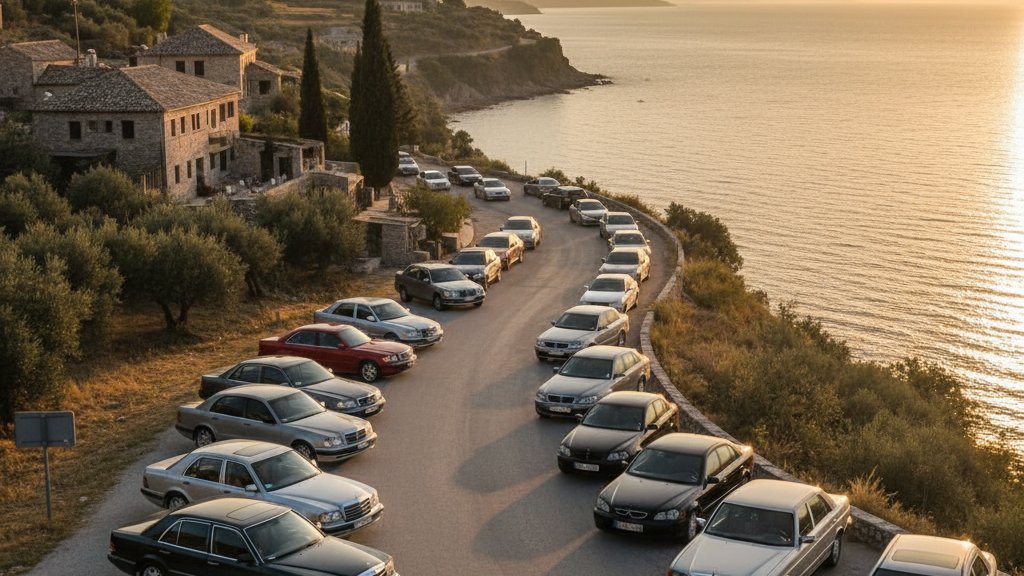
Drive through any Albanian city - Tirana, Durres, Vlora, or Shkoder - and you will notice an extraordinary pattern: every third or fourth vehicle carries the three-pointed star of Mercedes-Benz. This concentration of a single luxury brand is not random chance but the result of a unique convergence of historical events, cultural values, and economic realities that transformed Albania into one of Europe's most Mercedes-dense nations. Understanding this phenomenon reveals deeper truths about Albania's post-communist transformation, its relationship with Western symbols of success, and the practical demands of its challenging road infrastructure.
The Mercedes phenomenon in Albania represents more than automotive preference - it embodies a national narrative of aspiration, resilience, and adaptation. From the exclusive vehicles of communist party officials to the aspirational purchases of emigrant families returning from Germany, the Mercedes-Benz brand has tracked Albania's journey from isolation to integration with remarkable precision.
The Communist Legacy: When Mercedes Meant Power
The roots of Albania's Mercedes obsession trace back to the communist period between 1944 and 1991, when Enver Hoxha's regime maintained one of Europe's most closed economies. During this era, private car ownership was virtually non-existent - in 1990, Albania had fewer than 10,000 private vehicles for a population of over 3 million. The state owned the vehicles, and luxury imports were forbidden to ordinary citizens.
However, senior party officials, diplomats, and select state functionaries were granted access to Western automobiles, and Mercedes-Benz became the preferred choice for this elite class. The brand's German engineering, imposing presence, and international prestige made it the vehicle of choice for those with access to foreign currency and import privileges. A black Mercedes-Benz sedan became the visual signature of political power in Tirana.
This association created a powerful psychological imprint that persisted long after the regime's collapse. The Mercedes-Benz became encoded in the Albanian collective consciousness as the ultimate symbol of having "made it" - a tangible marker of elevation above the masses. When communism fell in 1991 and private ownership became possible, this embedded symbolism drove purchasing decisions across multiple generations.
The first wave of private Mercedes imports arrived immediately after 1991, often purchased by newly wealthy entrepreneurs who had profited from the chaotic privatization process. Owning the same brand that had once been reserved for party elites represented both a personal victory and a visible rejection of the old hierarchies. The Mercedes became a declaration: "I have succeeded where the old system failed."
The German Emigration Pipeline: How Migration Built Brand Loyalty
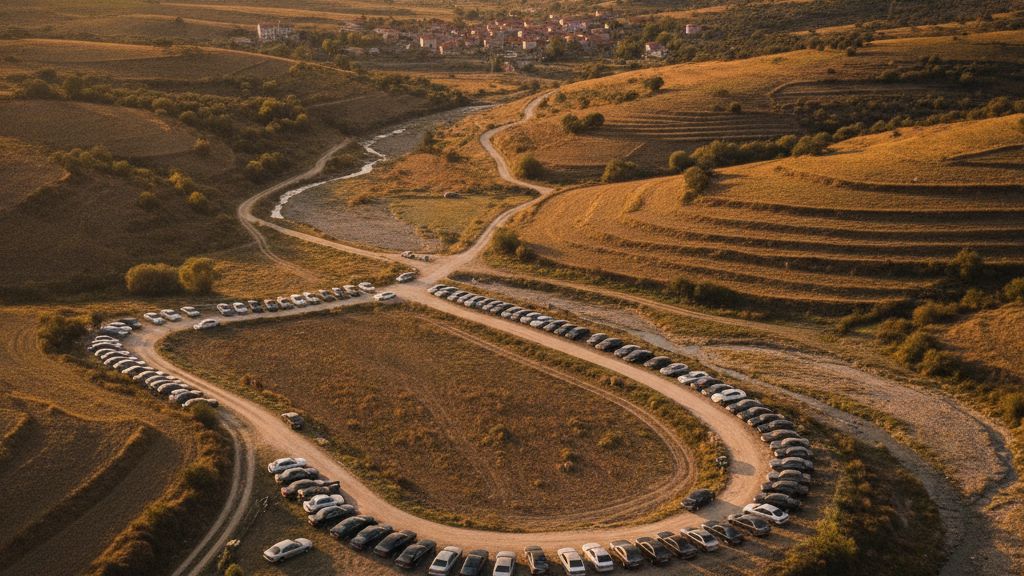
The second critical factor shaping Albania's Mercedes landscape was the massive wave of emigration to Germany throughout the 1990s and early 2000s. Conservative estimates suggest that over 400,000 Albanians relocated to Germany during this period, with many finding work in construction, manufacturing, and service industries. This diaspora community created a direct commercial pipeline between German automotive markets and Albanian roads.
Albanian workers in Germany observed that Mercedes-Benz vehicles retained value exceptionally well in the German used car market, and that older models with high mileage could be purchased affordably due to Germany's stringent emission standards and vehicle inspection regimes. A Mercedes E-Class or C-Class that could no longer meet German TUV requirements might be purchased for EUR 2,000-4,000 and driven or shipped to Albania, where it would command respect and provide years of reliable service on rougher roads.
This cross-border trade established Mercedes-Benz as the dominant import brand by sheer volume. Family networks facilitated transactions: a brother working in Munich would identify a suitable vehicle, arrange purchase and documentation, and either drive it to Albania or arrange shipping. The process became so routine that specialized transport companies emerged to move used Mercedes vehicles along the Munich-Tirana corridor.
The result was a self-reinforcing cycle. As more Mercedes vehicles entered Albania, mechanic shops developed specialized expertise in servicing them. Spare parts networks emerged to supply German-specification components. Knowledge accumulated about which model years offered the best reliability-to-price ratio. The infrastructure built around the brand made choosing Mercedes progressively more logical for subsequent buyers.
Planning to explore Albania's diverse terrain? Consider rental options from compact cars to SUVs suited for both coastal highways and mountain roads that these Mercedes models navigate daily.
Durability on Demanding Roads: Engineering Meets Reality
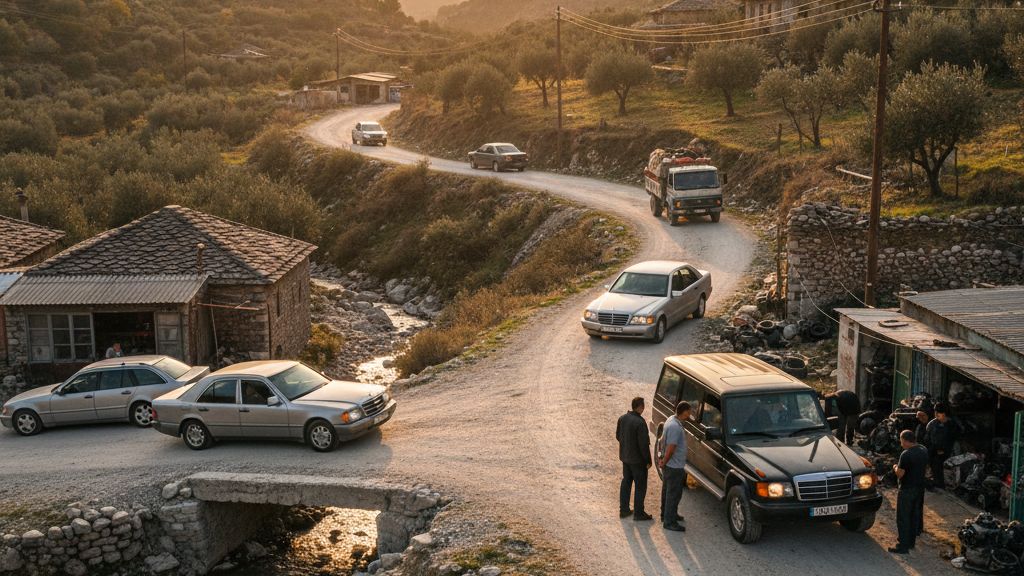
Albania's road infrastructure, while improving steadily since 2000, still presents challenges that eliminate less robust vehicles from consideration. Outside major arteries like the A1 motorway linking Durres to Morina, many roads feature broken pavement, potholes, and sections of gravel, particularly in mountainous regions. The route from Shkoder to Theth, for example, transitions from paved road to rough gravel track with minimal warning. Coastal routes can be neglected, and rural village access roads may see minimal maintenance.
Mercedes-Benz vehicles, particularly older W124 and W210 E-Class models from the 1990s and early 2000s, earned reputations for surviving these conditions where lighter vehicles struggled. The over-engineered German construction - reinforced chassis, robust suspension components, and generous ground clearance in certain models - meant these vehicles could absorb punishment that would sideline competitors.
Albanian drivers developed detailed knowledge about which Mercedes models handled local conditions best. The W210 E-Class with all-season tires became favored for mixed-surface driving. The ML-Class SUV, despite higher purchase cost, proved ideal for mountain routes. Even older W123 diesel models from the 1980s remain common in rural areas, where their simple mechanical design allows for roadside repairs and their fuel efficiency suits long-distance agricultural transport.
This practical durability reinforced the cultural prestige. A Mercedes wasn't just a status symbol - it was a rational choice for anyone needing reliable transportation across varied and unpredictable road surfaces. The brand delivered both social recognition and functional performance, a combination that few competitors could match in the Albanian market context.
Investment Logic: Value Retention in a High-Tax Environment
Albania's automotive taxation structure creates economic conditions that favor used vehicle imports, particularly of established premium brands. Import duties and VAT on new vehicles can approach 50% of the vehicle's value, placing new cars beyond the reach of most buyers. A new Mercedes-Benz C-Class that might cost EUR 45,000 in Germany could exceed EUR 65,000 after Albanian import duties, registration fees, and dealer markup.
In contrast, used vehicles face reduced taxation based on age and emissions standards, making a five-year-old imported Mercedes-Benz accessible at perhaps 25-30% of the new-car equivalent. This price differential creates strong incentives to buy used, and Mercedes-Benz vehicles have historically demonstrated superior value retention compared to volume brands in the Albanian secondary market.
The investment rationale works as follows: a used Mercedes E220d purchased for EUR 8,000 can be driven for three to five years with moderate maintenance and resold for EUR 5,000-6,000, representing a total ownership cost (excluding fuel and service) of EUR 2,000-3,000. An equivalent-age vehicle from a volume brand might be purchased for EUR 5,000 but resell for only EUR 2,000-2,500, yielding similar total ownership cost while lacking the Mercedes prestige.
This value retention is reinforced by the established market. With thousands of Mercedes vehicles already in circulation, buyer confidence remains high - everyone knows someone who has owned one, repair shops are familiar with them, and replacement parts are readily available. The brand has achieved the critical mass necessary for market liquidity, where a seller can find a buyer relatively quickly at a predictable price.
Social Signaling: The Mercedes as Cultural Currency
Beyond economics and engineering, the Mercedes phenomenon reflects deeper aspects of Albanian social dynamics. In a society that experienced extreme material deprivation during communism followed by rapid but uneven wealth creation, visible consumption serves important signaling functions. The vehicle you drive communicates your economic status, business success, and social positioning with remarkable efficiency.
Albanian business culture particularly values the visual demonstration of success. A entrepreneur arriving at a meeting in a Mercedes immediately establishes credibility and seriousness. The vehicle suggests that the individual has resources, maintains connections, and operates at a certain level. This perception can influence negotiation dynamics, partnership opportunities, and social access.
The preference extends across economic classes in adapted form. While wealthy individuals favor new S-Class or GLE models, middle-class professionals opt for used C-Class or E-Class sedans, and working-class families might share an older diesel Mercedes for both personal use and informal taxi work. Each group selects the Mercedes variant that matches their economic capacity while maintaining connection to the brand's symbolic value.
Interestingly, this pattern has created a Mercedes hierarchy within Albania itself. The newest models signal current wealth and success; late-model used vehicles indicate stable middle-class status; and older but well-maintained models demonstrate resourcefulness and connection to the brand's heritage. The three-pointed star remains constant while the vehicle's age and condition communicate nuanced social information.
The Rental Market: Mercedes for Albanian Adventures
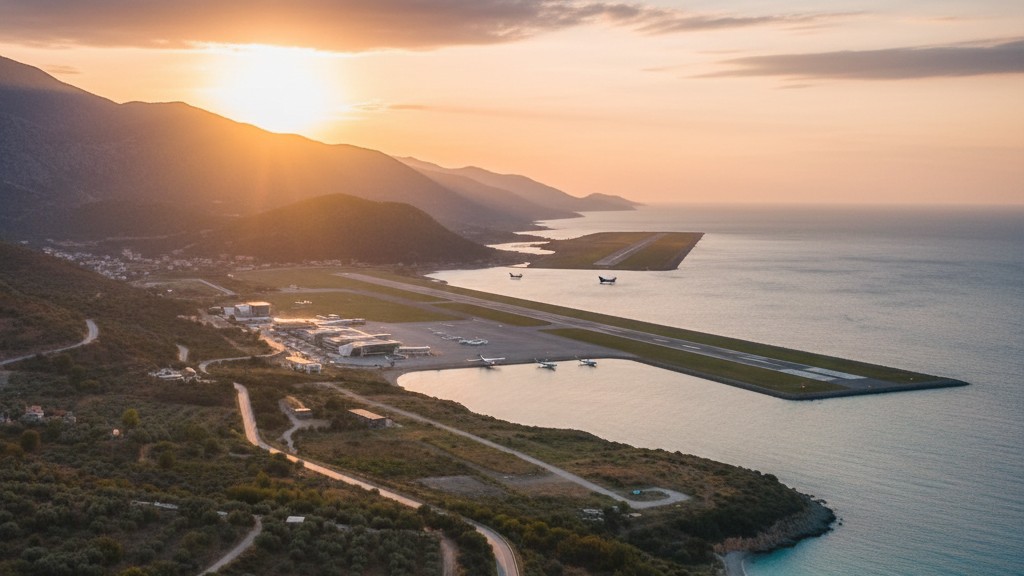
The Mercedes concentration has influenced Albania's car rental sector, where visitors can experience the phenomenon firsthand. Local rental companies in Tirana and at Tirana International Airport typically maintain fleets that include Mercedes models alongside more common rental options. Selecting a Mercedes rental allows tourists to understand the brand's appeal through direct experience on Albanian roads.
Rental operators report that Mercedes vehicles, particularly compact models like the A-Class and C-Class, perform well across Albania's diverse geography. The combination of comfortable highway cruising for coastal routes and sturdy construction for rougher inland roads makes them versatile options. For visitors planning mountain excursions or extended rural exploration, the brand's durability provides practical advantages beyond its cultural significance.
However, rental costs reflect the brand's premium positioning. Mercedes rentals typically command 20-40% higher daily rates than equivalent Japanese or Korean brand vehicles. For budget-conscious travelers, this premium may outweigh practical benefits, especially given that modern vehicles from any major manufacturer can handle Albania's main tourist routes. The choice becomes one of experience value: paying extra to drive the vehicle that embodies Albania's automotive culture versus opting for functional transportation at lower cost.
Changing Patterns: Will the Mercedes Dominance Continue?
Recent years have introduced factors that may gradually shift Albania's automotive landscape. European emission regulations have made older diesel Mercedes models increasingly expensive to maintain as parts become scarce and mechanical expertise ages. Younger Albanian buyers, particularly those who have grown up during Albania's EU integration process, show more diverse brand preferences influenced by global automotive trends.
Japanese brands, particularly Toyota and Honda, have gained market share by emphasizing reliability and lower maintenance costs. Korean manufacturers like Hyundai and Kia have entered with aggressive pricing on feature-rich models that appeal to value-conscious buyers. The rise of Chinese electric vehicles, backed by government incentives for zero-emission vehicles, may accelerate diversification as Albania modernizes its charging infrastructure.
Yet the Mercedes phenomenon demonstrates remarkable persistence. In 2025, Mercedes-Benz still accounted for approximately 18-22% of all passenger vehicles registered in Albania, a proportion that has declined only modestly from peaks above 25% in the early 2010s. The established infrastructure, cultural symbolism, and practical advantages create strong lock-in effects that resist rapid change.
For travelers exploring Albania today, the Mercedes dominance remains an immediately visible feature of the cultural landscape. Understanding its origins - the communist legacy, the German emigration pipeline, the road durability requirements, and the investment logic - transforms it from curious novelty into a lens for understanding Albania's modern history. The three-pointed star on Albanian roads tells stories of aspiration, adaptation, and the complex relationships between symbols, status, and practical survival.
What percentage of cars in Albania are Mercedes-Benz vehicles?
Current estimates suggest that Mercedes-Benz vehicles account for approximately 18-22% of Albania's passenger vehicle fleet as of 2025-2026, though the proportion varies significantly by region and vehicle age category. In urban centers like Tirana and Durres, the concentration can reach 25-28% among vehicles registered in the past 15 years. The proportion has declined modestly from historical peaks in the early 2010s when Mercedes represented over 25% of the national fleet, driven by increasing brand diversification among younger buyers and expanded availability of competing imports from Japan and Korea.
Why are older Mercedes-Benz models so common in Albania compared to other European countries?
Albania's unique position as a destination for used vehicle imports from Western Europe, particularly Germany, creates conditions where older Mercedes models remain economically viable and culturally valued. While German emission standards and inspection requirements phase out older vehicles domestically, these same vehicles find extended service life in Albania where regulations are less restrictive and road conditions actually favor the robust construction of older Mercedes engineering. The W124 and W210 E-Class models from the 1990s and early 2000s exemplify this pattern, remaining common in Albania while largely disappeared from German roads. The established parts supply network and mechanical expertise built around these older models further extends their practical lifespan.
How do Mercedes-Benz vehicles perform on Albania's challenging mountain roads compared to SUVs?
Traditional Mercedes sedans like the E-Class perform adequately on most paved mountain routes including the Llogara Pass on SH8 and the approach roads to destinations like Theth and Valbona, provided drivers exercise appropriate caution and the vehicles are equipped with all-season or winter tires during relevant seasons. However, for unpaved mountain tracks or severe gravel conditions, Mercedes SUV models like the ML-Class or GLE offer clear advantages through higher ground clearance and all-wheel drive systems. That said, experienced Albanian drivers demonstrate that even older Mercedes sedans can navigate surprisingly rough terrain when driven carefully, a testament to the brand's fundamental build quality that Albanian roads continue to test daily.
Does renting a Mercedes in Albania cost significantly more than other brands?
Rental pricing for Mercedes vehicles in Albania typically runs 20-40% higher than comparable vehicles from volume brands, though exact premiums vary by model, season, and rental duration. A Mercedes C-Class might rent for EUR 50-70 per day during peak summer season compared to EUR 35-50 for a Toyota Corolla or similar vehicle of equivalent size and features. The premium reflects both the brand's prestige positioning and the higher insurance and maintenance costs associated with premium vehicles. For travelers prioritizing budget efficiency, this premium may not justify the marginal practical benefits, as modern vehicles from any reputable manufacturer can handle Albania's main tourist routes safely and comfortably.
What are the most common Mercedes-Benz models currently seen on Albanian roads?
The Albanian Mercedes landscape features distinct model generations based on import timing and durability characteristics. Among sedans, the W210 E-Class from 1995-2002 remains remarkably common, valued for reliability and road durability, while the W211 successor from 2002-2009 has grown in prevalence as these vehicles age out of Western European markets. The W203 C-Class from 2000-2007 serves as the entry-level Mercedes choice for middle-class buyers. In the SUV category, the ML-Class from early 2000s models through recent GLE variants appears frequently, favored for rural use and mountain access. Older W123 diesel models from the 1980s persist in agricultural regions, representing the extreme end of Mercedes longevity under demanding conditions.
How did the collapse of pyramid schemes in 1997 affect Mercedes ownership in Albania?
The collapse of fraudulent investment schemes in 1997, which wiped out the savings of approximately two-thirds of Albanian households, created a complex impact on Mercedes ownership patterns. The immediate aftermath saw some luxury vehicle sales as individuals liquidated assets to recover losses, temporarily increasing used Mercedes availability and suppressing prices. However, the crisis also accelerated emigration to Western Europe, particularly Germany, as Albanians sought economic stability abroad. This emigration wave ultimately reinforced the Mercedes pipeline as workers abroad later purchased and imported vehicles, demonstrating how crisis and recovery patterns interacted with automotive preferences over extended timeframes.
Are diesel or petrol Mercedes-Benz vehicles more popular in Albania and why?
Diesel Mercedes models dominate Albanian preferences by an estimated ratio of 70:30 over petrol variants, driven primarily by fuel cost economics and the diesel engine's reputation for longevity under demanding conditions. Diesel fuel in Albania typically costs 10-15% less per liter than petrol, and diesel engines generally deliver 20-30% better fuel efficiency, creating significant operating cost advantages for high-mileage users including taxi operators and rural drivers. The legendary durability of Mercedes diesel engines, particularly older mechanical injection models that can accumulate 400,000-500,000 kilometers with proper maintenance, reinforces this preference. However, tightening European emission standards have reduced the supply of affordable used diesel imports, gradually shifting recent purchases toward petrol as availability and cost calculations change.
What role do Albanian mechanics play in maintaining the Mercedes-Benz concentration?
The specialized ecosystem of Albanian mechanics trained specifically in Mercedes service and repair represents a critical but often overlooked factor sustaining the brand's dominance. Major cities contain multiple independent workshops dedicated exclusively to Mercedes vehicles, staffed by technicians who have developed expertise through years of working on the specific model generations common in Albania. These mechanics understand the particular wear patterns that Albanian road conditions create, stock appropriate spare parts, and charge service rates substantially below official dealer pricing. This infrastructure creates a self-reinforcing advantage: high Mercedes concentration supports specialized service capacity, which in turn reduces ownership costs and risks, making Mercedes purchase more attractive to new buyers. The knowledge transfer from master mechanics to apprentices perpetuates this expertise across generations.
Comments (14)
"I recently visited Albania and was amazed at the number of Mercedes-Benz cars on the road. After speaking with locals, I learned that owning a Mercedes is a symbol of success and status in Albanian culture. It was wonderful to see so many people achieving their dreams and enjoying the finer things in life. What a great testament to the hard work and determination of the Albanian people!"
Yes, you're right. In Albania they are very fond of Mercedes cars. By the way, we have them in our fleet. You can rent one.
I just stumbled upon this article on the "Why are there so many Mercedes in Albania" topic and I am blown away! Firstly, I want to express my huge appreciation to the author and the website for shedding light on this intriguing phenomenon. As a keen traveler, I have always been fascinated by the unique and interesting culture of Albania, but I never knew about this curious trend. The in-depth analysis of the reasons behind this trend is simply outstanding. The article is well-researched, informative and presents a fresh perspective on the socio-economic situation in Albania. The author skillfully highlights the cultural and historical significance of the Mercedes brand in Albania and thoroughly explains the societal factors that have led to this trend. Moreover, I really appreciate the author's objective and unbiased approach to the subject matter. The article is not just a random collection of opinions; it provides facts and figures to back up the claims made. The author presents both sides of the coin and leaves the readers to draw their own conclusions. Overall, this article is a fantastic read! It is thought-provoking, educational and beautifully presented. It opens up a whole new world for me and inspires me to explore the wonderful country of Albania further. I cannot help but feel grateful to have stumbled upon this website, and to the author for their insightful contribution. Keep up the great work!
Yan, that's an extended commentary. Thank you very much. We will keep you happy with new articles.
"It appears that the popularity of Mercedes-Benz cars in Albania can be traced back to the early 1990s, following the end of communist rule in the country. As demand for imported luxury vehicles rose, Mercedes-Benz quickly became a preferred choice among Albanian motorists due to its reputation for quality, reliability, and prestige. Additionally, many Albanian families emigrated to Germany during that time and returned with Mercedes cars, adding to the popularity of the brand. Overall, it seems that the combination of historical events and cultural preferences have contributed to the high number of Mercedes cars seen on Albanian streets today."
The popularity of Mercedes-Benz cars in Albania can be attributed to the demand for imported luxury vehicles in the 1990s after the end of communist rule. Mercedes-Benz's reputation for quality, reliability, and prestige made it a preferred choice among Albanian motorists. The brand's popularity was also fueled by Albanian families who emigrated to Germany during that time and returned with Mercedes cars. The combination of historical events and cultural preferences contributed to the high number of Mercedes cars on Albanian streets today.
"OMG, have you guys seen how many Mercedes there are in Albania?! It's insane! Everywhere you look, there's another luxurious car driving by. I mean, I've heard that Albanians love Mercedes and take great pride in owning them, but I never expected to see this many on the streets. It just goes to show how much the people here value style and luxury. I can't wait to see what other surprises Albania has in store for me!"
The prevalence of Mercedes-Benz cars in Albania is remarkable, as Albanians take great pride in owning them. This trend highlights the value that Albanians place on style and luxury. It is exciting to see what other surprises Albania has in store.
"During my recent visit to Albania, I noticed a noticeable presence of Mercedes cars on the roads. It could be due to several factors, such as the country's geographical location and proximity to Europe, where the brand is popular. Also, Mercedes cars are a sign of prestige and wealth in Albanian culture. Additionally, the country has relatively lenient import regulations, making it easier for Albanians to purchase these high-end vehicles. Overall, the prevalence of Mercedes in Albania is an interesting observation worth exploring further."
The notable prevalence of Mercedes cars on the roads in Albania may be due to various factors, including the country's proximity to Europe, where the brand is popular, and the association of the brand with prestige and wealth in Albanian culture. The relatively lenient import regulations in Albania also make it easier for Albanians to purchase these luxury vehicles. This observation raises interesting questions worth exploring further.
"It's interesting to see such a high prevalence of Mercedes in Albania, and there are likely a few factors at play. The country has a history of importing used cars, and Mercedes may be perceived as a status symbol due to their luxury branding. The vehicles also have a reputation for durability and reliability, which may make them a popular choice for Albanians. Additionally, the country's rugged terrain and narrow roads may make a sturdy and maneuverable car like a Mercedes a practical option for navigating the landscape."
The high prevalence of Mercedes in Albania may be due to several factors, including the country's history of importing used cars, the luxury branding of Mercedes as a status symbol, and their reputation for durability and reliability. The rugged terrain and narrow roads in Albania may also make a sturdy and maneuverable car like a Mercedes a practical option. Overall, these factors likely contribute to the popularity of Mercedes in Albania.
"I am truly blown away by the unprecedented number of Mercedes Benz vehicles in Albania. The love and admiration for the brand is truly infectious and it's not hard to see why! The sleek and stylish design, advanced technology, and superior performance of the cars are impressive, making them the ultimate status symbol. It's amazing how Albanians have embraced and celebrated luxury in their lifestyle through these vehicles. I am grateful for the opportunity to witness this phenomenon firsthand and I can confidently say that Albania's love affair with Mercedes Benz is truly an admiration to behold!"
Thank you!